
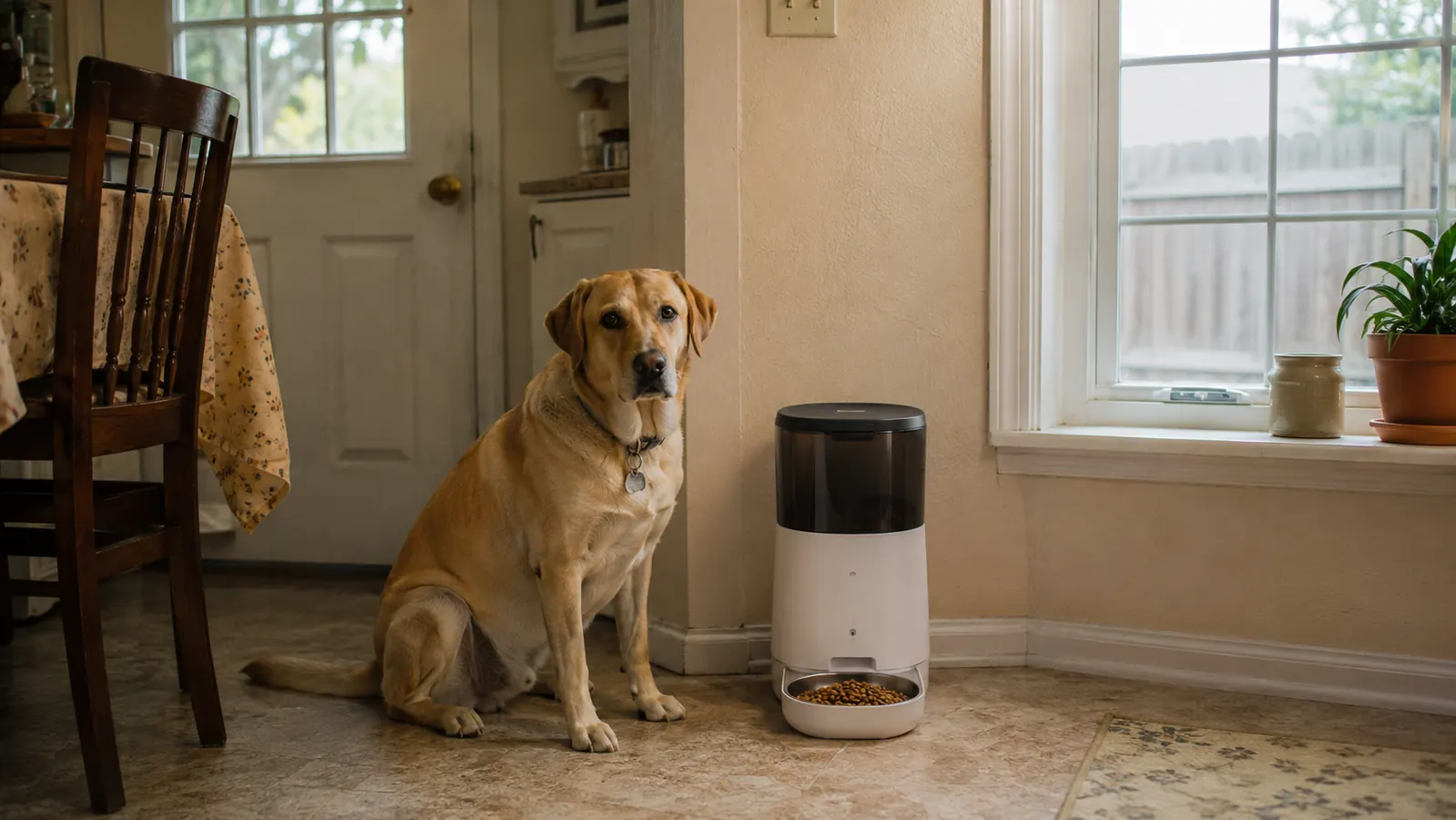
Biscuit is a Lab mix, which means if I let him, he would eat his entire day's worth of food in about ninety seconds and then spend the rest of the afternoon staring at the pantry door like it owes him money. For a long time our feeding schedule was whatever I could manage around a full-time job, which in practice meant a big breakfast before I left, nothing until I got home, and a dinner that landed anywhere between 5:30 and 7:30 depending on traffic and how my shift went. He was fine, technically, but he was also anxious by late afternoon, begging harder, and clearly hungrier than a dog on a reasonable schedule should be.
What actually fixed it wasn't just buying a gadget. It was working out a real plan for his day and then using an automatic feeder to hold that plan steady even when I'm not home to enforce it myself. I ended up going with the PetSafe 5 Meal feeder because it let me split his food into more compartments than the average two-meal models, and honestly it's been the one piece of his routine I don't have to think about anymore. Below is the full method, not just the gadget part, because the feeder only works if the plan behind it is right.
See the feeder that finally made Biscuit's schedule stick
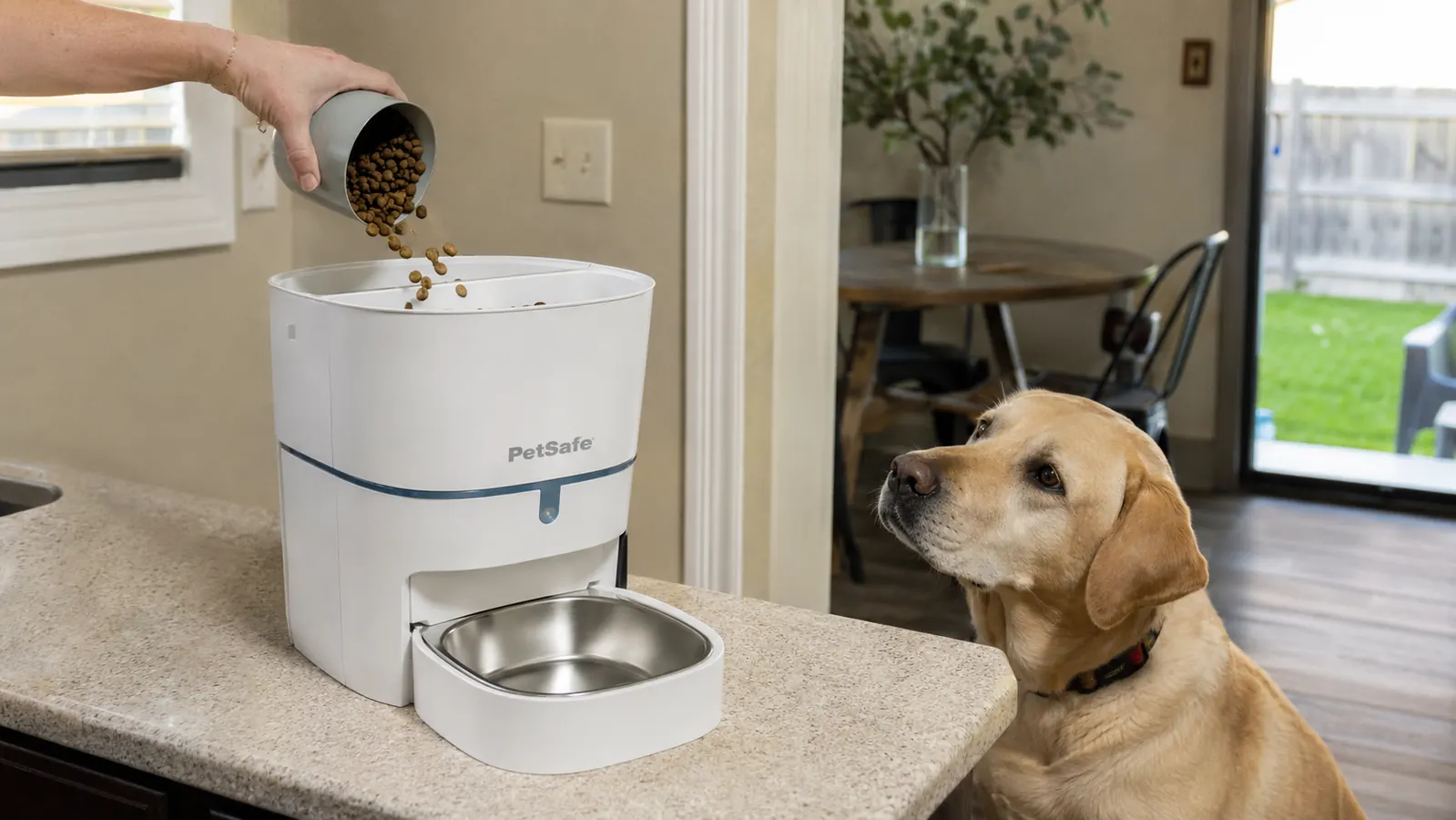
This is the automatic feeder I use, five separate compartments, a feed-now button for treats, and a dishwasher-safe tray that's held up to a large dog's daily use without cracking.
Amazon Check Today's Price on Amazon →Step 1: Work Out Your Dog's Actual Daily Portion With Your Vet
Before I touched a feeder at all, I went back to basics on how much Biscuit should actually be eating in a day. I had been going off the chart on the back of the kibble bag, which lists a wide range and assumes an average dog doing average things. Biscuit is 68 pounds, food motivated in a way that makes him a little too eager to finish whatever's in front of him, and gets a decent amount of exercise between our yard and our evening walks. At his last checkup I asked our vet directly for a daily calorie target based on his weight, age, and activity level, and it came out noticeably lower than what the bag suggested.
This step feels like it can wait, but it's the one everything else depends on. An automatic feeder is only as good as the number you program into it. If that number is wrong, you've just automated overfeeding or underfeeding on a very reliable schedule. A five-minute conversation at your next appointment, or even a quick call to your vet's office, is worth doing before you set anything up.
I also asked specifically about treats, since Biscuit gets a handful through the day for training and just being a good boy. Our vet had me count treat calories against his daily total instead of adding them on top, which meant his actual kibble portion came down a bit further once treats were factored in.
Step 2: Split That Portion Across Several Smaller Meals
Once I had a real daily total, the next question was how to break it up. I'd been doing two meals, but our vet mentioned that more frequent, smaller meals tend to keep dogs steadier through the day, less of a hard hunger spike before the next feeding, and less pressure on the stomach in one sitting. For a dog like Biscuit who inhales food fast, smaller portions also just mean less to gulp at once.
I landed on four meals a day for him, spaced out from early morning to early evening, which the five-compartment feeder handles easily with room to spare if I ever want to add a fifth small portion. The math is simple: take the daily total your vet gave you and divide it by however many meals you want to run. I keep his math on a sticky note inside the pantry so I never have to redo it from memory when I refill the hopper.
Maple, our senior Beagle, actually benefits from this same approach for a different reason. She's stiff in the mornings and doesn't always want a big meal right when she wakes up, so a smaller first portion followed by another a couple hours later suits her a lot better than one large breakfast she has to force down while she's still working the kinks out of her back legs.
Step 3: Program the Feeder to Match the Plan, Not to Guess
With the portion and meal count settled, setting up the actual feeder took maybe ten minutes. Each compartment on the PetSafe 5 Meal feeder holds up to a cup, so I measured out Biscuit's per-meal portion with a dry measuring cup and loaded each slot to match, rather than eyeballing it or filling every compartment to the top out of habit. The dishwasher-safe tray underneath makes cleanup easy enough that I actually do it weekly instead of putting it off.
I set the feeding times to line up with the schedule I'd already worked out, not the other way around. It's tempting to just spread meals evenly across whatever hours are convenient for the feeder's settings, but the schedule should come from your dog's actual day, your work hours, walk times, and bedtime, with the feeder programmed around that, not the reverse.
The feed-now button turned out to be more useful than I expected. I use it occasionally to release a small extra portion as a training reward without messing with the programmed schedule underneath, which keeps his regular meals untouched while still letting me reward good behavior in the moment.
Step 4: Shift Onto the New Schedule Gradually, Not All at Once
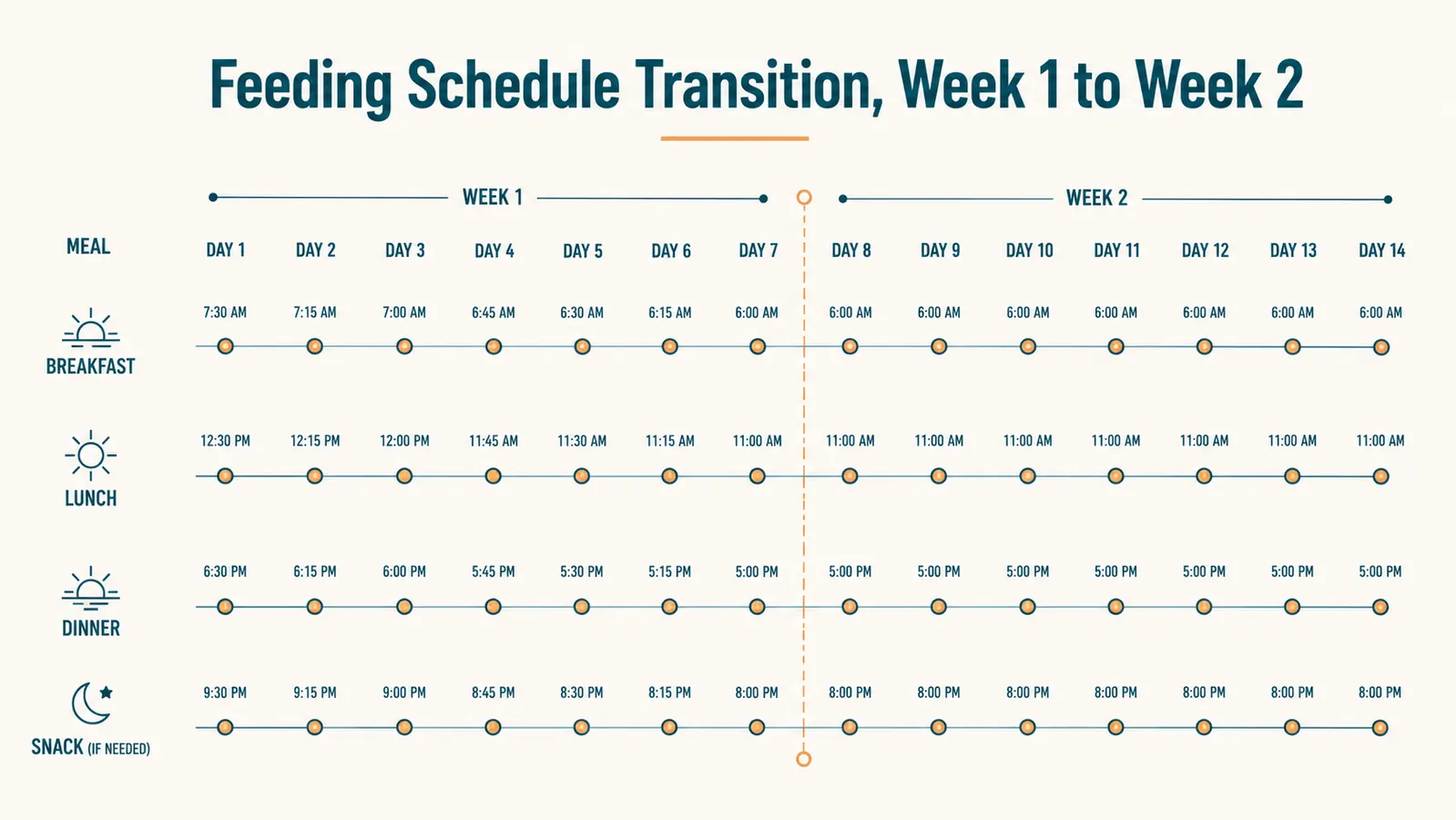
I made the mistake the first time of switching Biscuit straight from his old two-meal routine to the new four-meal schedule overnight. He was confused for a couple of days, hovering near the feeder at times he used to get fed and pacing when nothing happened. It wasn't a disaster, but it was avoidable stress I could have skipped.
The second time I did this with a schedule adjustment, I moved meal times by fifteen to thirty minutes a day over about a week and a half until we landed on the final times. That slower shift meant his body and his expectations moved together instead of getting yanked from one routine into a totally different one. If your dog is more food-anxious than Biscuit, or older like Maple, I'd stretch that transition out even longer rather than shorter.
During the transition, I stayed close to the feeder at each mealtime so I could reassure him if he seemed unsettled by the new timing. That extra attention for a week or two made the eventual hands-off schedule land a lot more smoothly than if I'd just set it and walked away from day one.
Step 5: Put the Feeder Somewhere a Determined Dog Can't Wreck It
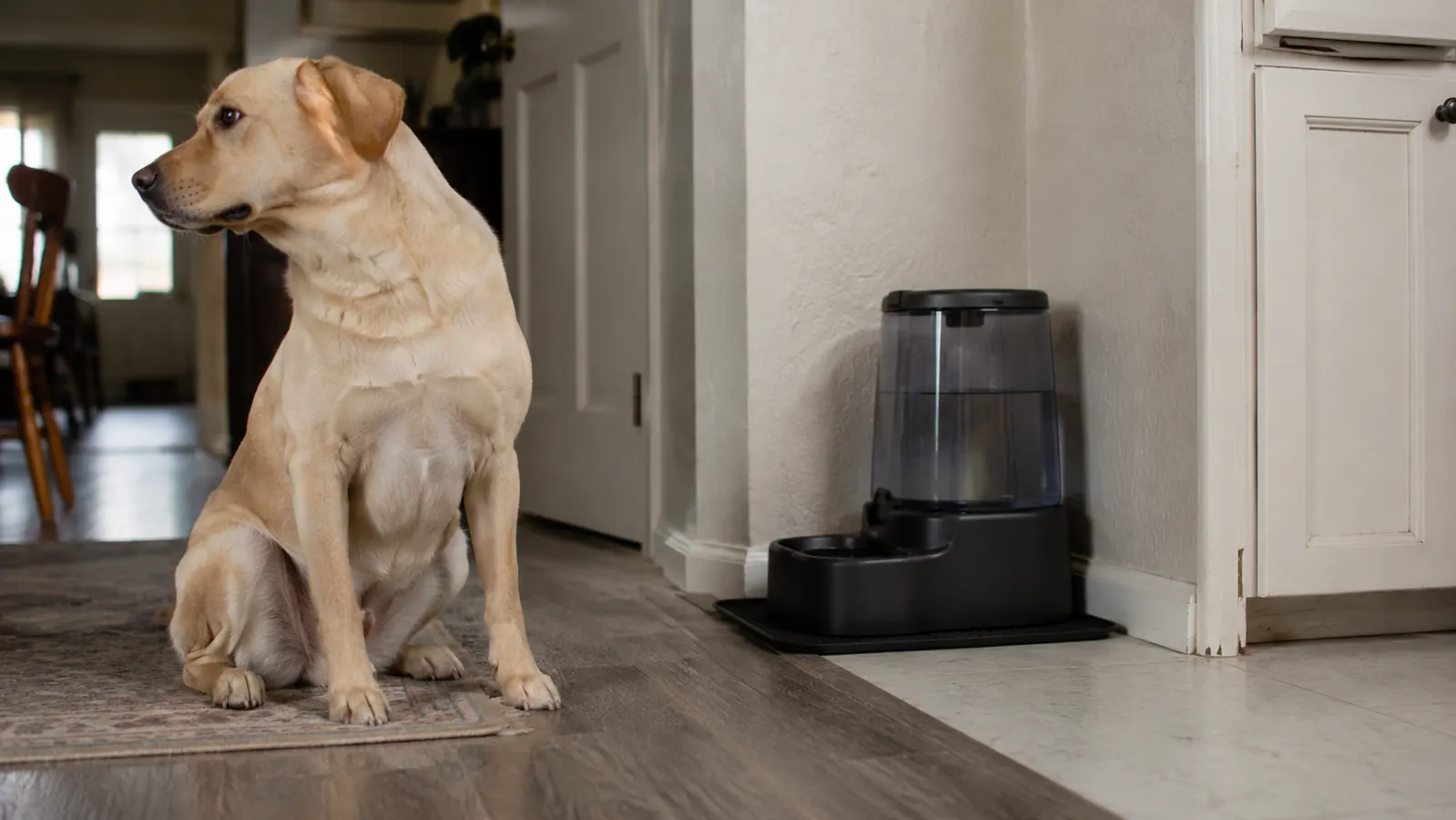
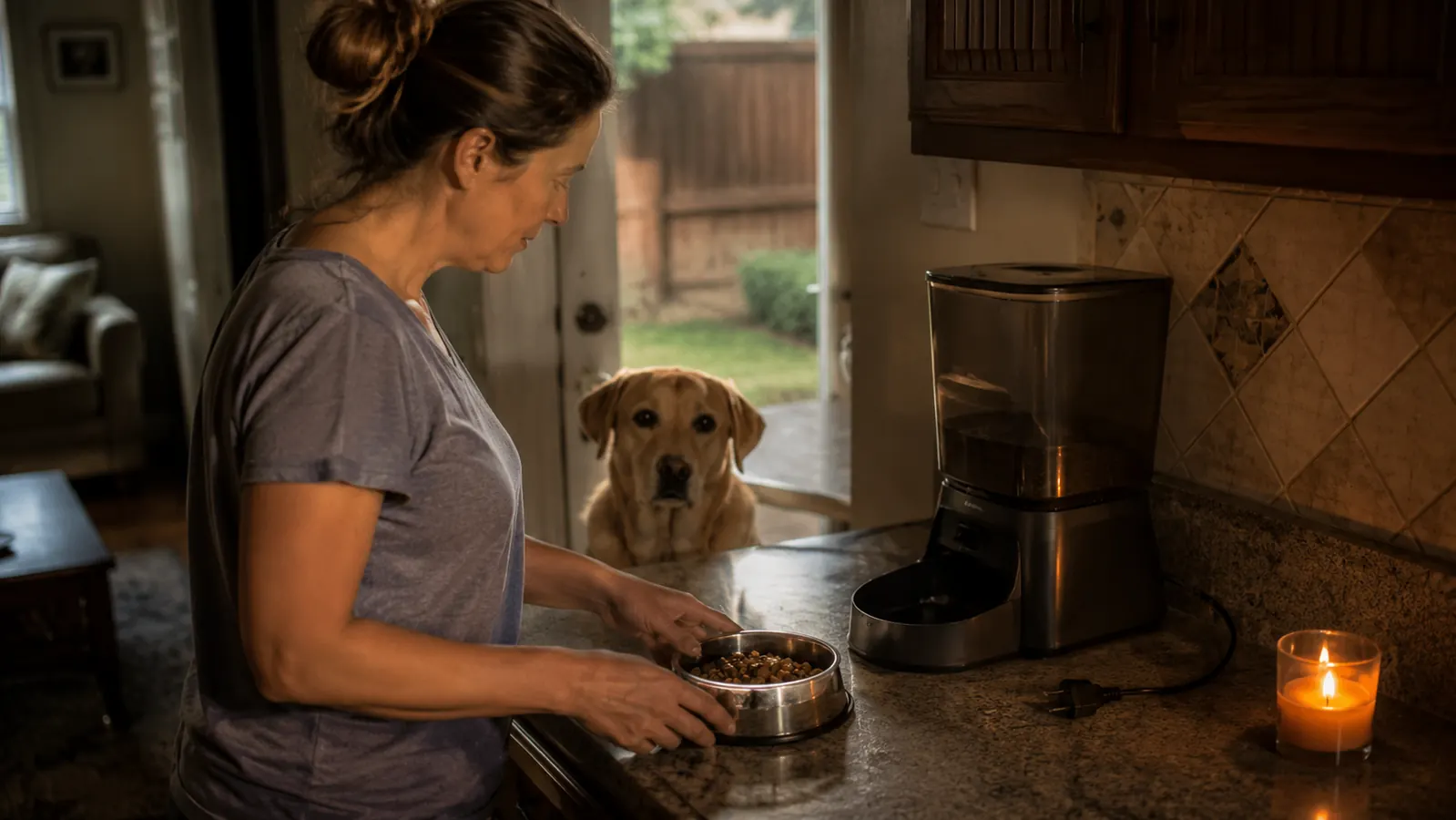
Biscuit is strong enough and curious enough that an unsecured feeder was never going to survive on its own in the middle of our kitchen floor. The first week I had it out in the open, he nosed it a few inches across the tile trying to get at the next compartment early, and I could tell it was only a matter of time before he figured out how to tip it or pry the lid open with a paw.
I moved it into a low corner of the kitchen, tucked against two walls so there's nothing for him to get leverage against, and set it on a thin rubber mat so it doesn't slide on the tile. For a dog with a habit of body-slamming things when he's excited, this kind of placement matters more than people expect. If your dog is even more determined than mine, some owners go a step further and secure the base to a wall bracket or a heavy non-slip pad rated for larger dogs.
Pepper, our cat, took a few interested laps around the feeder in the first week too, mostly out of nosiness rather than any real attempt to get into it. Cats generally can't operate the mechanism the way a strong-nosed dog might try to, but it's still worth placing the feeder somewhere your other pets can't easily knock it over or squeeze underneath while investigating.
Step 6: Test-Run It for a Few Days While You're Still Home
I didn't trust the feeder with a full workday until I'd watched it run correctly a few times while I was actually in the house. For about four days, I let it dispense meals on schedule while I stayed nearby, just to confirm the portions were coming out right, the compartments were rotating in order, and Biscuit wasn't finding some clever way to get an extra meal early.
That test-run period is also when I noticed small things worth adjusting, like the fact that Biscuit startles slightly at the mechanism's click the first couple of times it opens. By the third day he'd learned the sound meant food was coming and started perking up instead of flinching, which told me he'd adjusted and I could trust it running while I was out of the house.
I'd genuinely recommend this step to anyone setting up an automatic feeder for the first time, even if the instructions make it look simple enough to trust immediately. A few days of supervised runs costs you nothing and catches problems before they turn into a missed meal or a confused, hungry dog while you're at work.
Step 7: Keep a Manual Backup Plan for Power or Battery Failure
The feeder runs on batteries, and I check them on a set day each month rather than waiting for a low-battery warning to catch me off guard on a workday. I keep a spare set in the kitchen drawer right above where the feeder sits, so a swap takes thirty seconds instead of becoming a scramble.
I also keep Biscuit's next scheduled portion measured out in a small container in the pantry as a manual backup. If I ever came home to a feeder that hadn't dispensed for some reason, dead batteries, a jam, whatever, I want to be able to feed him by hand immediately rather than troubleshooting a machine while a hungry dog waits. It's a small habit that costs nothing and takes the pressure off the feeder being perfect every single time.
A neighbor mentioned she'd had her power go out for half a day while she was traveling and had a pet sitter check in specifically because her feeder had no battery backup at the time. That stuck with me. A backup plan isn't about distrust of the feeder, it's just what you'd want in place for any appliance your dog's meals depend on.
What Else Helps
A couple of smaller things have made the whole system run smoother. I keep a fresh water bowl refilled on the same rounds I check the feeder, since a consistent eating schedule works best alongside consistent water access. I also keep Biscuit and Maple's feeding areas separated by a few feet so Biscuit, who finishes first every time, doesn't hover over Maple's slower morning meal and rush her through it.
I want to be honest about the limits of all this too. An automatic feeder is a tool for keeping a good schedule consistent, not a reason to stretch how long a dog is left alone. I still make sure someone checks in on both dogs within a normal window every day, feeder or no feeder, because meals are only one part of what a dog needs while you're away. And if a dog who's normally eager to eat suddenly stops finishing meals or ignores the feeder altogether, that's not something to fix with a schedule tweak. That's a reason to call your vet, since a sudden appetite change can point to something that needs actual medical attention, not a different meal time.
The feeder didn't fix Biscuit's begging by itself. Working out the right portion first, then letting the feeder hold that plan steady, is what actually did it.
It took a couple of weeks to get the full system dialed in between the portion math, the gradual schedule shift, and finding the right spot for the feeder itself. But almost a year in, Biscuit's afternoon begging has mostly disappeared, and I don't spend my lunch break wondering whether he's going to demolish something out of hunger before I get home. That's really what this whole method is for, not a fancier feeding routine for its own sake, just a predictable one that holds up on an ordinary workday.
Ready to build a schedule your dog can count on?
If you're juggling a work schedule against a hungry, food-motivated dog, the PetSafe 5 Meal feeder is the tool that let our plan actually stick, five separate compartments, a simple feed-now button, and an easy-clean tray.
Amazon Check Today's Price on Amazon →