
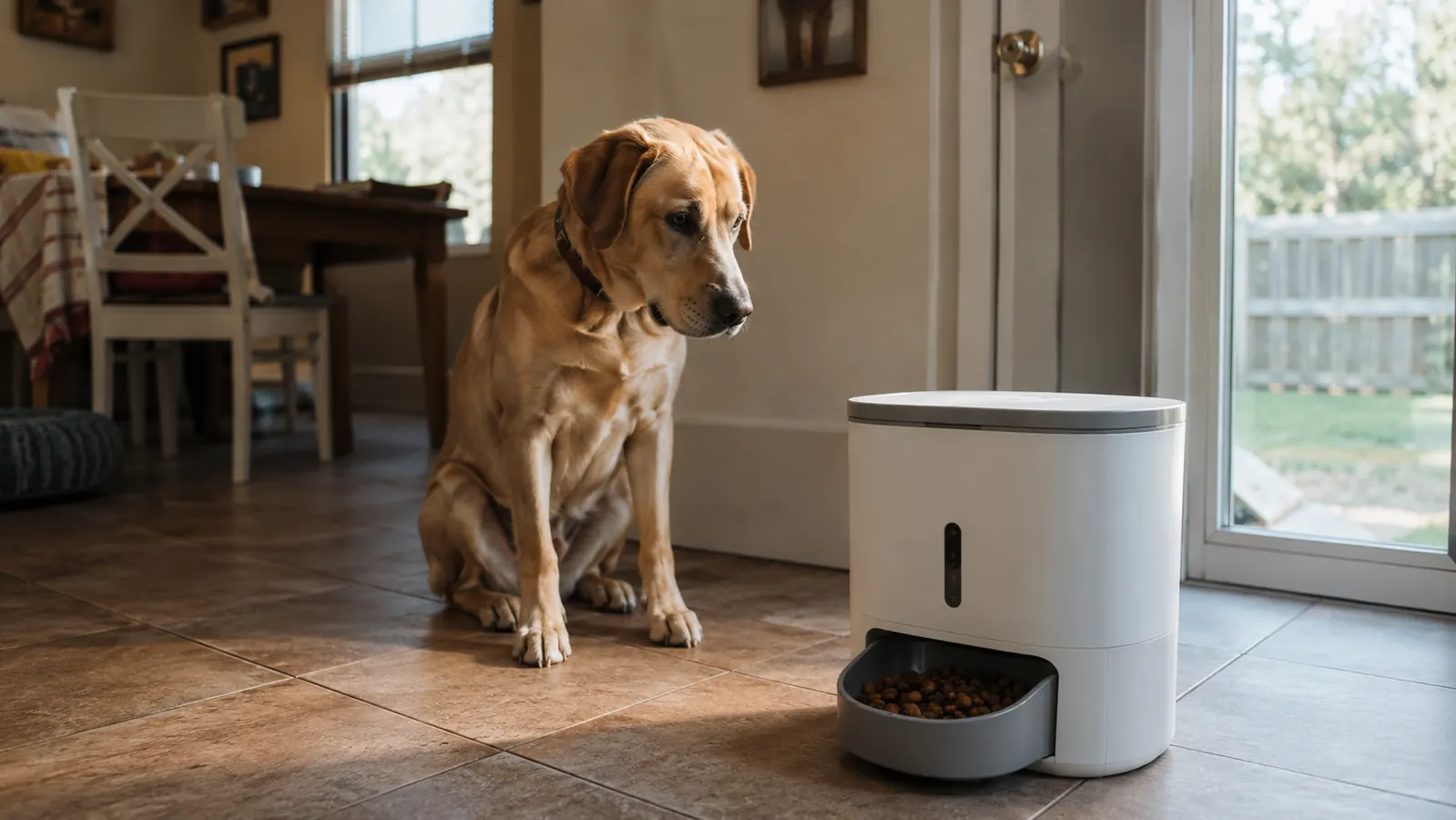
My dog Biscuit has never met a food source he didn't try to negotiate with. He's a Lab mix, he's a little over a year old when I bought this feeder, and he treats the pantry door, the cat's bowl, and the trash can as three separate ongoing projects. So when I tell you I bought the PetSafe 5 Meal automatic feeder partly because I work full time and partly because I needed something Biscuit couldn't out-stubborn, that's not a joke. It's the actual reason.
I've had this feeder running in my kitchen for six months now, feeding Biscuit's midday meal on the days my shift runs long, and occasionally covering Maple's dinner when I get held up. Maple is my other dog, a senior Beagle who gets stiff in the mornings, and she doesn't rush her food the way Biscuit does, which turned out to matter more than I expected. This is the honest, day-by-day version of how the PetSafe feeder held up, not the first-week honeymoon review.
Before this feeder, my routine involved a neighbor with a spare key stopping by on my longer shifts, and I hated relying on that. It felt like I was always apologizing or texting a favor, and I'm not great at asking for help twice in the same month. Buying an automatic feeder felt almost silly at first, like something for a fancier setup than mine, but a small house and a full-time job don't leave a lot of room for anything complicated.
So this review covers the whole six months, not just the good week when everything worked out of the box. Some parts held up exactly like I hoped. A couple of things surprised me, and not always in a good way. I'll walk through it in the order I actually learned it, starting with day one.
The Quick Verdict
Reliable on schedule, held up to six months of daily use, but portion accuracy drifted slightly and it's not fully Biscuit-proof.
Amazon Check Today's Price →Tired of rushing home to feed on time? This is the fix I actually use.
The PetSafe 5 Meal feeder holds up to five scheduled meals of dry food, each compartment measuring a full cup, so you can set it once and stop watching the clock.
Amazon Check Today's Price on Amazon →How I've Used It
I set the feeder up on a Sunday afternoon at my kitchen counter, and it took about fifteen minutes start to finish, most of that spent reading the little manual twice because I didn't trust myself to program five meal times correctly on the first try. The unit runs on four D batteries, which I liked at the time because it meant I could put it wherever made sense without hunting for an outlet. Six months in, I've replaced those batteries exactly once, closer to the four-month mark than I expected.
For the first few weeks I used it strictly as a backup, feeding Biscuit by hand in the morning and letting the feeder cover his midday cup on the days I worked a double shift. By month two it had basically become his regular midday feeding, and by month three I'd added a second daily slot for Maple's evening meal on nights I get stuck late.
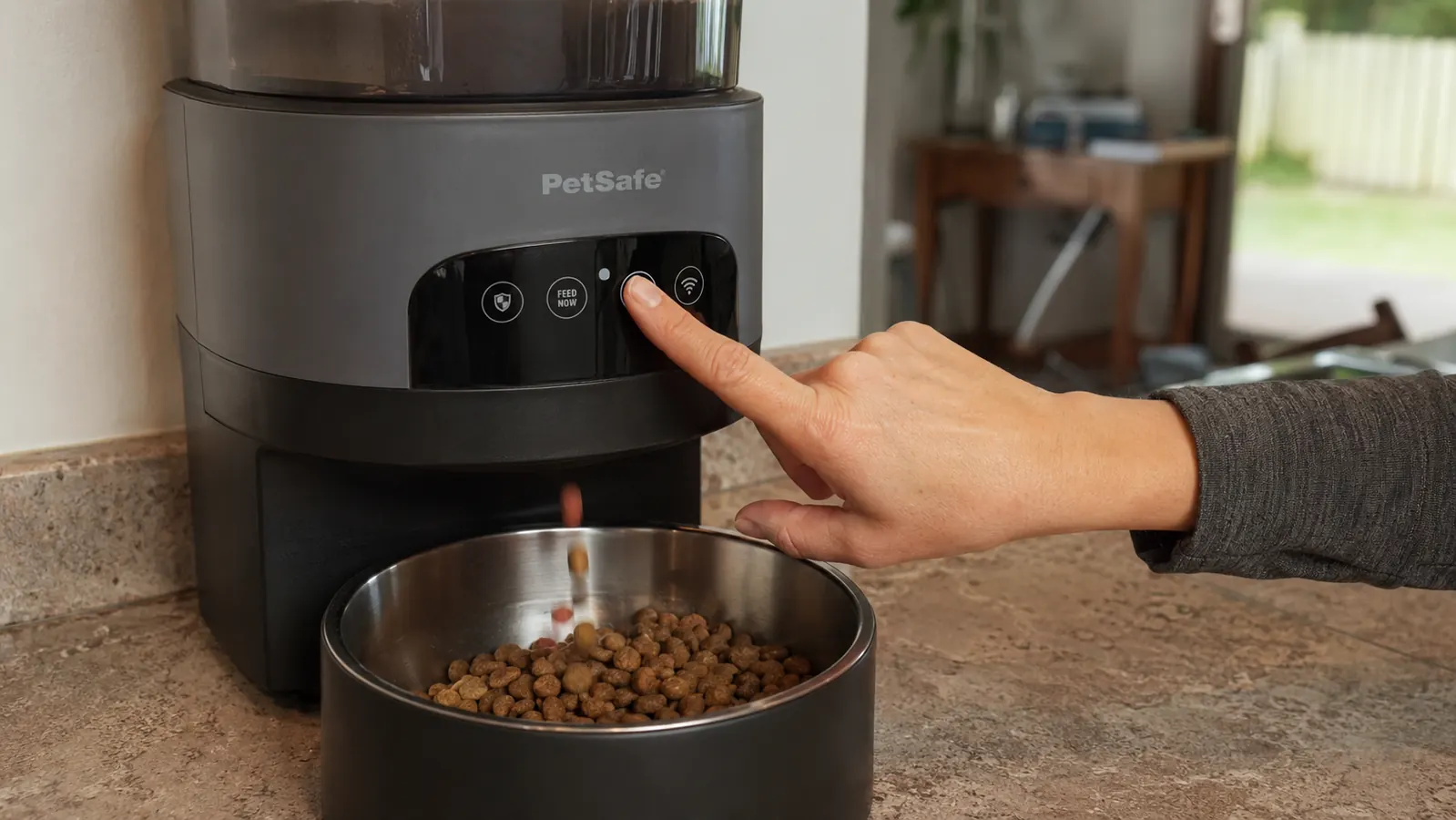
What sold me early on wasn't anything fancy. It was the feed-now button. On the days when my schedule genuinely falls apart, I can hit that button remotely, sorry, not remotely, I mean right there on the unit, and get a dog fed on time without doing math about compartments in my head.
I also ended up placing the feeder on a low shelf near the laundry room instead of the main kitchen floor, mostly because Pepper, my cat, decided within the first two days that the feeder's tray was a personal challenge. She never managed to get into it, but she tried enough times that I moved it somewhere less tempting, and that solved the problem completely.
Battery Life, Six Months In (The Reality)
PetSafe doesn't promise a specific battery lifespan on the packaging, and I get why. My real-world number, running two scheduled meals a day for six months, was right around four months on one set of D batteries before the low-battery indicator started blinking. That's not bad, but it's also not the six-plus months some online reviews claim, and I think the difference comes down to how often you're pressing that feed-now button. I use mine a lot, so my batteries work harder than someone running it strictly on a fixed schedule.
The bigger issue for me wasn't the battery life itself, it was the warning system. The low-battery light is small and easy to miss if the feeder is tucked in a corner, which mine is, because Biscuit needs it out of easy nose-reach. I found out my batteries were dying because a scheduled meal simply didn't dispense one morning, not because I noticed the indicator. That's a real gap if you're depending on this for a dog with a medical feeding schedule.
My fix now is boring but it works. I put a battery-change reminder on my phone for the first of every month, whether the feeder needs it or not. It's one extra thing to manage, and I'd rather tell you that upfront than let you find out the way I did.
I've also started keeping a spare set of D batteries in the kitchen junk drawer specifically for this feeder, the same way I keep spare smoke detector batteries on hand. It sounds like overkill until the one morning it isn't, and after the missed-meal scare, I decided I'd rather have batteries I never end up needing than run this feeder on a wing and a prayer.
Portion Accuracy: Does It Drift Over Time
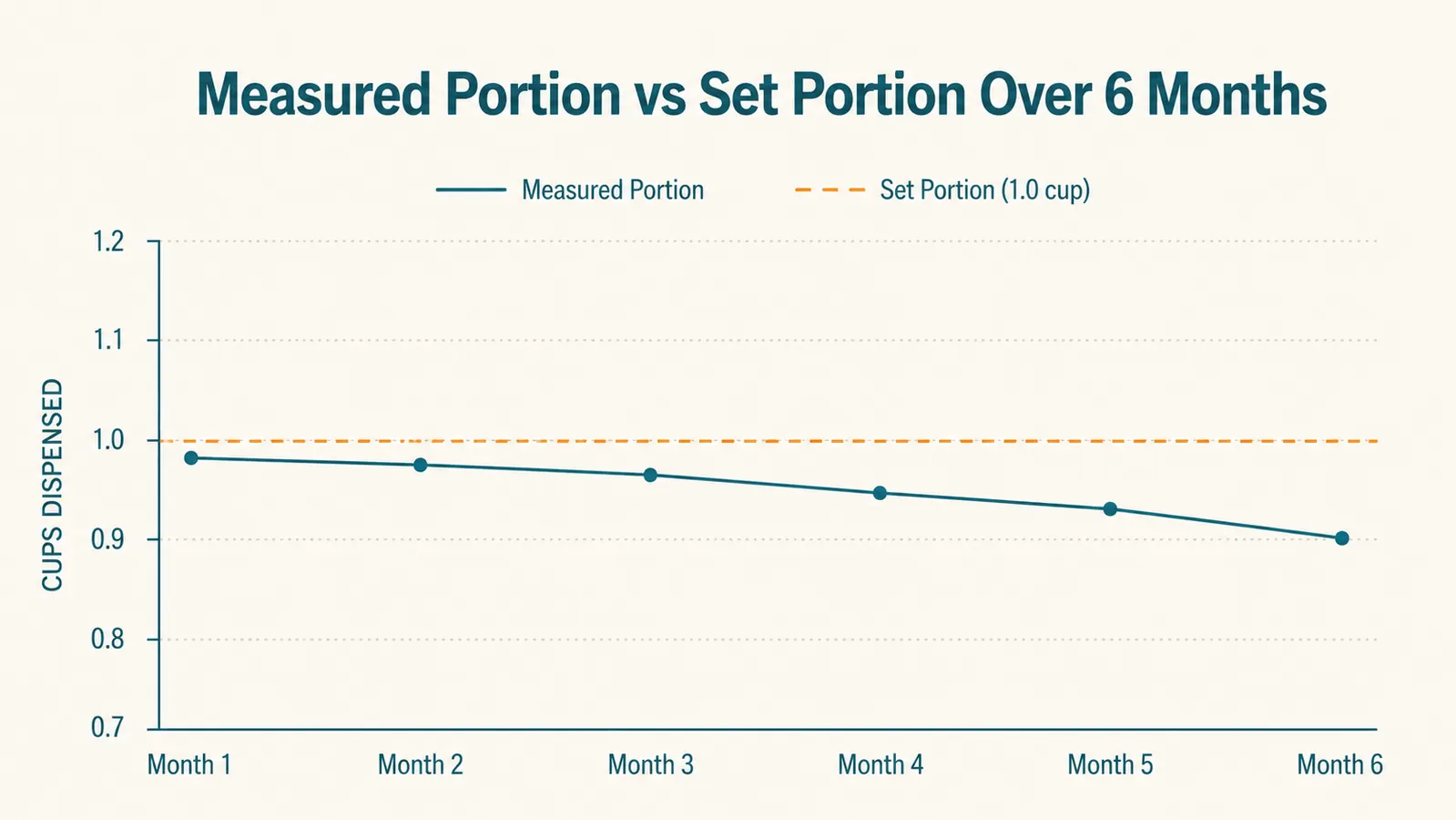
Each compartment is built to hold one cup, and for the first two months, mine dispensed close to a true cup every time, measured against my own dry-food scoop just to check. Starting around month three, I noticed Biscuit's bowl looked a little lighter some mornings, so I started actually measuring it instead of eyeballing it.
Over months three through six, the average dispensed portion drifted down to somewhere around 0.9 cups instead of a full cup, not every time, but often enough that it wasn't just my imagination. I think it's a combination of kibble dust building up around the rotating tray and the auger not always fully clearing a compartment on the first pass. It's a small drift, not a dramatic one, but if you're feeding a dog on a strict vet-recommended portion for weight management, it's worth checking your dog's actual bowl weight every few weeks rather than trusting the compartment blindly.
For Biscuit, who could stand to lose a pound or two anyway, the slight under-portioning honestly hasn't hurt anything. For a dog who needs precise calorie control for a medical reason, I'd treat this feeder as close enough, not exact enough.
Kibble Shapes That Jam the Auger
This is the part nobody mentions until you live with it. The feeder handles small, uniform kibble without complaint. The larger, irregular pieces in some grain-free formulas are a different story. I switched Maple's food brand around month four, and her new kibble has these oddly shaped triangular pieces that jammed the rotating tray twice in the same week.
Both times, the fix was the same. Unplug the batteries for a second, gently work the jammed piece loose with a chopstick through the dispensing chute, and reset the schedule. It's a two-minute annoyance, not a disaster, but it means checking your dog's specific kibble shape before you assume this will run maintenance-free. Smaller round or oval kibble, like what Biscuit eats, has never jammed once in six months.
If your dog's food runs large or oddly shaped, I'd genuinely test a small batch through the feeder before committing to it as your only feeding method. It's not a dealbreaker, but it's the single biggest source of frustration I've had with this unit, and it's the one thing that made me consider returning it during month four before I figured out the workaround.
Cleaning and the Noise at Dispense Time
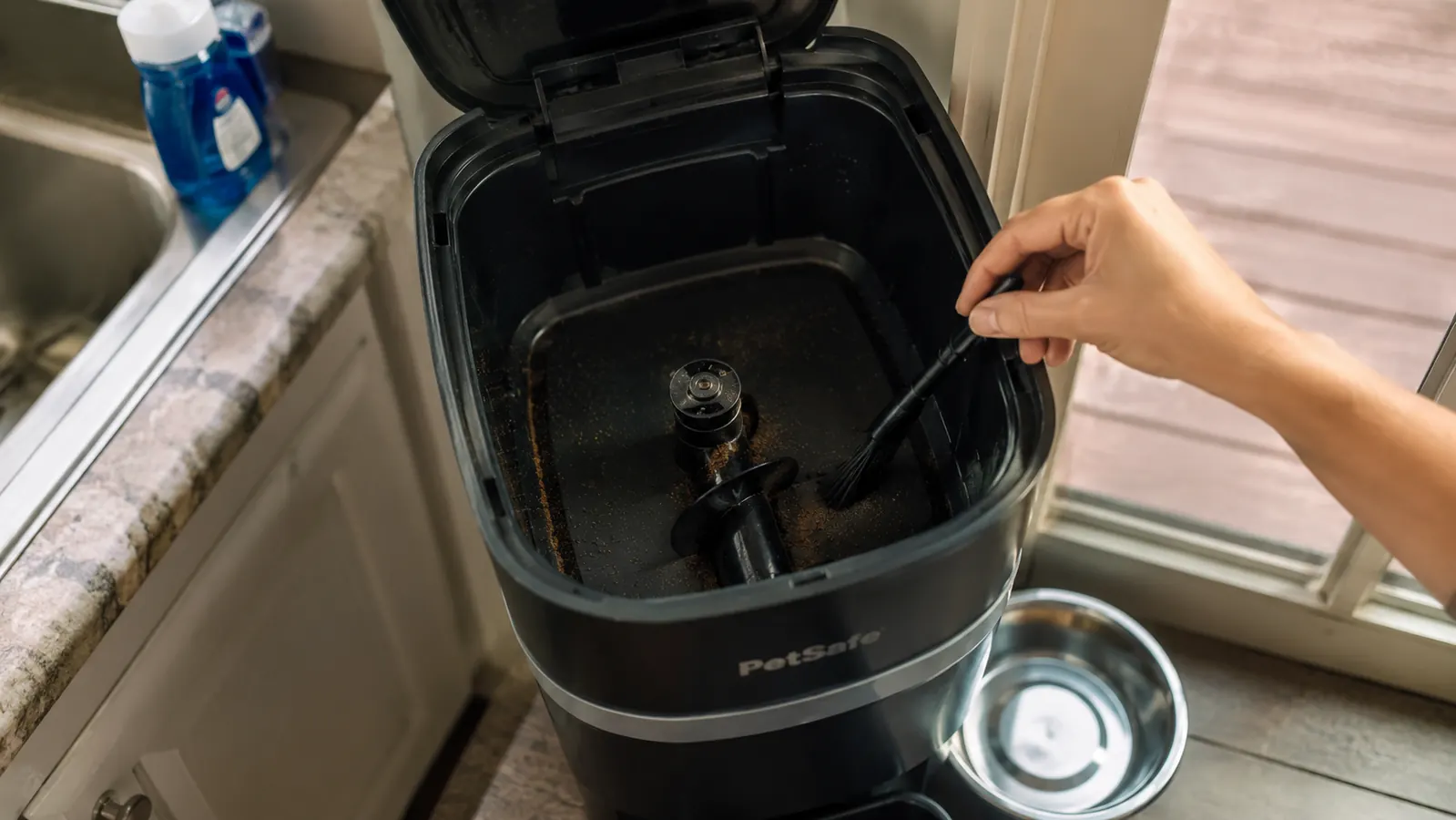
The bowl and tray are dishwasher safe, which I use about every ten days, and that part is genuinely easy. The hopper itself is a different chore. Kibble dust settles around the auger no matter what you're feeding, and I've gotten into a habit of pulling it apart with a dry brush roughly once a week to keep that dust from building into the kind of gunk that eventually causes a jam.
As for noise, the motor makes a distinct grinding whir every time it dispenses, loud enough that it wakes me up if a meal is scheduled for early morning in a quiet house. Biscuit, for what it's worth, has learned that sound means food is coming and now beelines for the kitchen the second it starts, which somewhat defeats the purpose of scheduling meals for when I'm not home to referee, but it's not the feeder's fault that my dog is smart about food.
The noise level is worth knowing about if your feeding schedule includes anything close to your own bedtime or an early wake-up you're trying to avoid. It's not obnoxiously loud, but it's not silent either.
One small thing I didn't expect, the plastic housing has held up better than I thought it would given how much Biscuit has nosed at it over the months. No cracks, no discoloration, and the buttons still respond the same as they did on day one. For a plastic appliance living on my kitchen floor, that's held up better than a few other things I own.
What I Liked
- Feed-now button is genuinely useful on chaotic days
- Dishwasher-safe bowl and tray make routine cleaning simple
- Held up to six straight months of daily two-meal use without breaking
- Battery-powered setup means placement isn't limited by outlets
Where It Falls Short
- Portion accuracy drifted to roughly 0.9 cups after month three
- Low-battery indicator is easy to miss and cost us one missed meal
- Larger or irregularly shaped kibble can jam the auger
- Motor noise is noticeable enough to wake a light sleeper
It's not a set-it-and-forget-it machine. It's a set-it-and-check-on-it-monthly machine, and once I accepted that, it earned its spot on my counter.

Who This Is For
If you work full time like I do and need a backup for the meals you can't always be home for, this feeder does the job. It's also a solid pick if your dog eats small, uniform kibble, since that's where it runs into the fewest problems. For a dog like Maple, whose stiff mornings mean she's in no hurry to eat right away anyway, the fixed schedule has actually helped keep her mealtimes more consistent than my own memory ever did.
It's also a good fit if you're the type who'll actually build a monthly battery check into your routine, the way I finally did. A little maintenance discipline goes a long way with this feeder, and if you're willing to give it that, it pays you back with a lot less scrambling on your busiest days.
Who Should Skip It
If your dog needs exact, medically precise portions, or your dog's kibble runs large and irregularly shaped, I'd look at a pricier model with a more precise auger before committing to this one. And if you're someone who won't remember to check batteries once a month, that low-battery indicator being easy to miss is a real risk, not a minor quibble.
I'd also skip it if your household includes a light sleeper close to the kitchen, since the dispense motor is loud enough to notice through a wall. Weigh that against how much you actually need the scheduling help, because for us, the trade was worth it.
Still better than a missed meal and a guilty conscience.
Six months in, this feeder still earns its spot on my counter. If your schedule looks anything like mine, it's worth checking the current listing.
Amazon Check Today's Price on Amazon →