
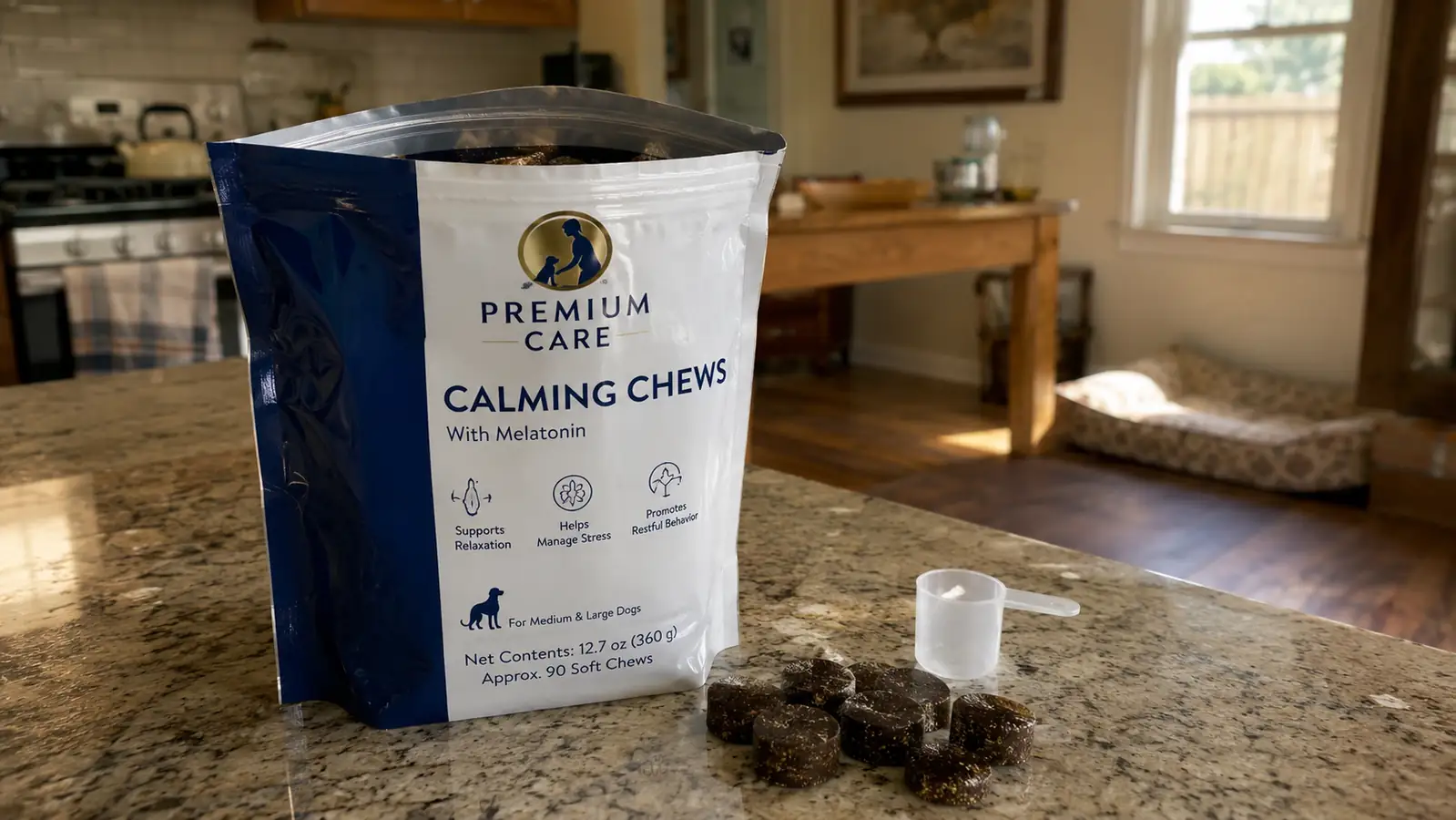
I almost didn't write this one, because the honest version of this review isn't as tidy as the ones I usually post. Calming chews for dogs sit at right around a 4.0 star average on Amazon, with just under fifty thousand reviews behind that number, and that's noticeably lower than almost anything else I recommend on this site. I've used this exact bag with my own dog Biscuit, a food-motivated Lab mix, through more than one storm season, and I've also read a genuinely uncomfortable number of the one-star reviews trying to figure out what's actually going on. My conclusion, after all that reading and all that using, is that the 4.0 average is telling the truth. This product works well for a real chunk of dogs and does close to nothing for another chunk, and a lot of the difference comes down to things that have nothing to do with the bag itself.
So this isn't going to be a cheerleading review. It's going to be the version I wish someone had written before I bought my first bag, the one that tells you why the reviews are split, where people mess up the timing, what's actually in these chews versus what the marketing implies, and, just as importantly, who should skip this entirely and call their vet instead.
The Quick Verdict
A genuinely useful, low-stakes supplement for everyday stress in dogs like Biscuit. Not a sedative, not a fix for real separation anxiety, and easy to use wrong if you don't understand the timing.
Amazon Check Today's Price →Curious whether the 4.0 average would land differently for your dog?
The only way to know is to try a bag and pay attention to timing. Check today's price and current availability on Amazon.
Amazon Check Today's Price on Amazon →How I've Actually Used These
I started giving Biscuit calming chews after a bad storm night a couple of summers ago, the kind where he ended up wedged behind the toilet in our tiny bathroom, drooling and shaking. Since then I've used them ahead of storms, before car rides, before vet visits, and on the Fourth of July, which is the one night a year I actually plan our whole evening around. Biscuit takes to them without any drama at all. He's a food-motivated dog who'll eat a sock off the counter without blinking, so a soft chew that smells like a treat is not a hard sell. He usually settles a little faster and paces less once I've gotten his timing right.
My other dog, Maple, a senior Beagle who's stiff in the mornings, doesn't get the same use case. She isn't panicky in the way Biscuit gets during storms, so I've never had a real reason to give her calming chews regularly. I bring her up because it matters for this review: not every dog needs this product, and a lot of the mismatch in reviews comes from people trying it on a dog whose problem was never really about calm in the first place.
I also want to be upfront that I've read through a large stack of other people's reviews for this specific product, both the glowing ones and the frustrated ones, because I wanted this article to be more than just my own experience with one dog. What I found lines up with what I've seen firsthand, and it's the backbone of everything below.
Why the Rating Sits at 4.0 Instead of 4.5
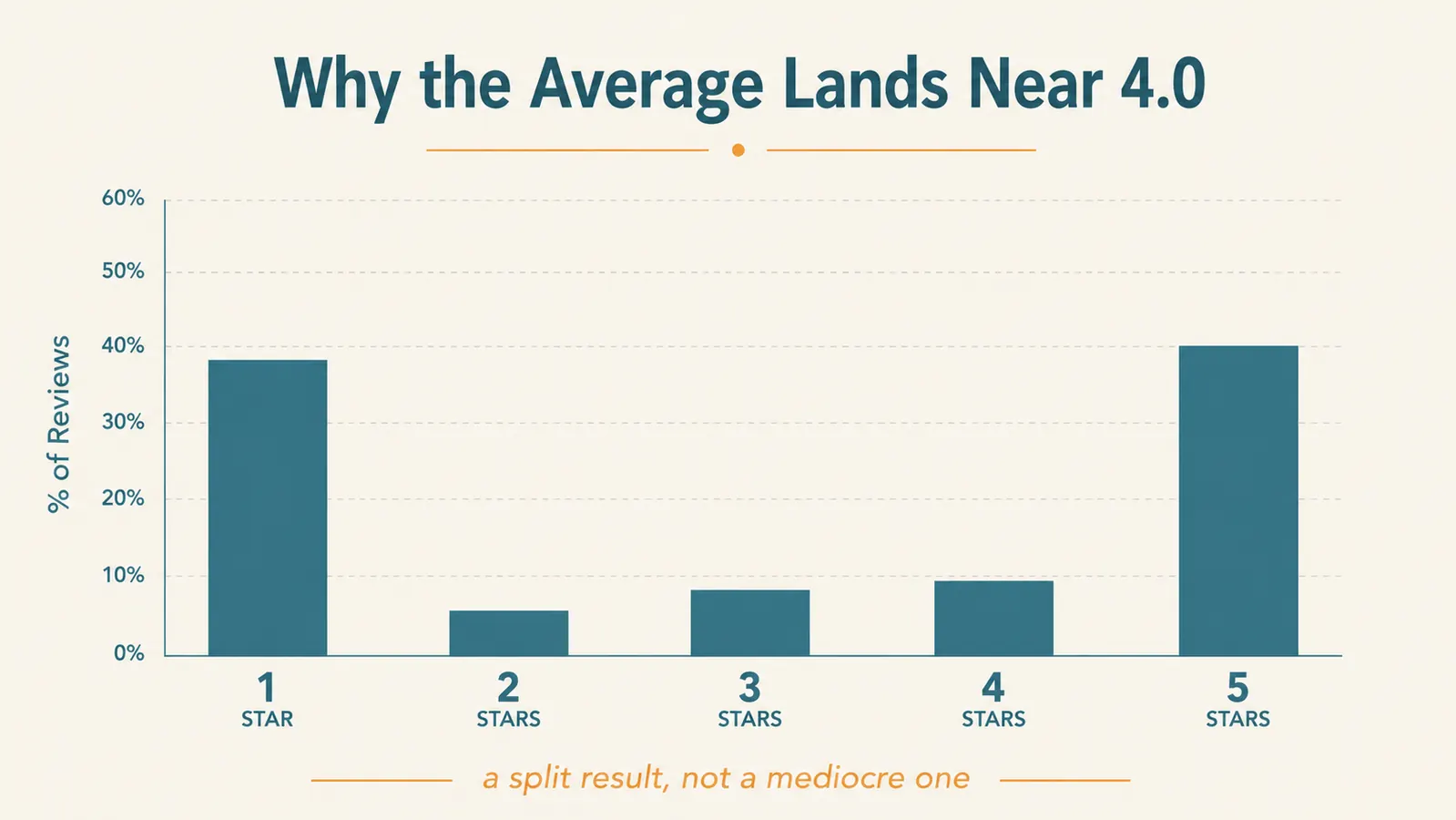
A 4.0 average with tens of thousands of reviews isn't a mediocre product getting mediocre reviews. If you actually look at the distribution, it's mostly five-star and one-star reviews with a thinner middle, which is a very different shape than a product everyone rates a flat three. That pattern usually means one thing: the product does something real for a lot of dogs, and does basically nothing, or actively disappoints, for another group. Both things can be true about the same bag of chews at the same time.
The five-star reviews tend to describe exactly what I've seen with Biscuit. A dog who used to pace and pant through a storm settles down faster. A dog who drooled through every car ride tolerates the drive better. Nothing dramatic, just a noticeably calmer version of the same dog. The one-star reviews, when I actually read the text instead of just the star count, cluster around a much smaller number of complaints than you'd expect. Dogs that refused to eat the chew at all. Owners who gave it during a panic attack that was already underway and saw no change. And a fair number of people who seem to have expected something closer to a sedative than a mild supplement, and felt let down when their dog didn't get sleepy or zoned out.
None of that means the product is secretly great or secretly bad. It means the rating is doing exactly what a rating is supposed to do, reflecting a genuinely mixed real-world result. I'd trust a split 4.0 with this many reviews over a suspiciously smooth 4.8 any day.
It's a Supplement, Not a Sedative, and That Trips People Up
This is probably the single biggest source of disappointment I saw across the negative reviews, and it's worth saying plainly. This product is not a sedative. It's a mild supplement built around melatonin, L-theanine, chamomile, and a B vitamin or two, and none of those ingredients are designed to knock a dog out or override a genuine panic response. If you're picturing something closer to a prescription sedative that a vet might use before a flight or a surgery, you're going to be underwhelmed no matter what bag you buy.
What it's actually built to do is take a small amount of edge off ordinary situational stress, the kind Biscuit gets during a storm or a car ride, not override a dog's nervous system. On his better nights, he's noticeably less frantic about finding a hiding spot and settles into the storm faster once the thunder starts. He doesn't turn into a different dog. He turns into a slightly calmer version of himself. That's genuinely all a mild supplement like this is designed to do, and expecting more than that is where a lot of one-star reviews come from.
The Timing Mistake I See in Almost Every Bad Review
If I had to pick one fixable reason this product underperforms for people, it's timing. The chews are meant to be given twenty to thirty minutes before a known trigger, not during it and not after it's already started. A dog who's already mid-panic, pacing, drooling, trying to bolt, is not in a place where a mild supplement is going to change much of anything, and giving it in that moment is a bit like handing someone a chamomile tea in the middle of a car accident. It might help the aftermath a little, but it's not going to touch the acute moment.
I learned this the hard way with Biscuit early on. The first couple of times I gave him a chew right as the storm hit, and I honestly couldn't tell if it did anything. Once I started giving it well ahead of the forecast, roughly a half hour before the sky even looked bad, the difference became noticeable. He still reacts to thunder, but the buildup is calmer and he settles faster once the storm actually arrives. Reading through other reviews, I'd bet a meaningful share of the one-star ratings are describing exactly this mistake, giving it too late and concluding the product doesn't work, when the real issue is timing.
The other timing wrinkle is that some dogs seem to respond better after a few uses than on the very first try. If you give it once, see nothing, and give up, you may be judging the product on an unfair sample size. I'd give it at least three or four proper, well-timed tries before deciding one way or the other, and I'd keep a quick note on my phone of what I gave, when, and what happened, because after the third or fourth storm they all start to blur together and you lose the pattern you're actually trying to spot.
The Ingredients Are Mild, and the Evidence Behind Them Is Thin
I think honesty requires saying this plainly too. Melatonin, L-theanine, chamomile, and a B vitamin like thiamine are all common, generally well-tolerated ingredients, and melatonin in particular has some real research behind it for sleep and situational stress in dogs. But the research on the whole combination, at the doses used in an over-the-counter chew, is thinner than the marketing copy on some of these listings would suggest. Nothing in this bag is going to be backed by the kind of large, rigorous studies you'd see for an actual prescription medication, and I don't think any responsible reviewer should imply otherwise.
What that means practically is that you're trying something mild, reasonably well-tolerated, and genuinely helpful for some dogs, not something with guaranteed, clinically proven results. I think that's a completely fair thing to try given how low the cost and risk are. I just don't think it's fair to market it, or review it, like it's more scientifically settled than it is.
A Food-Motivated Dog Eats It Happily. An Anxious Dog Might Refuse It
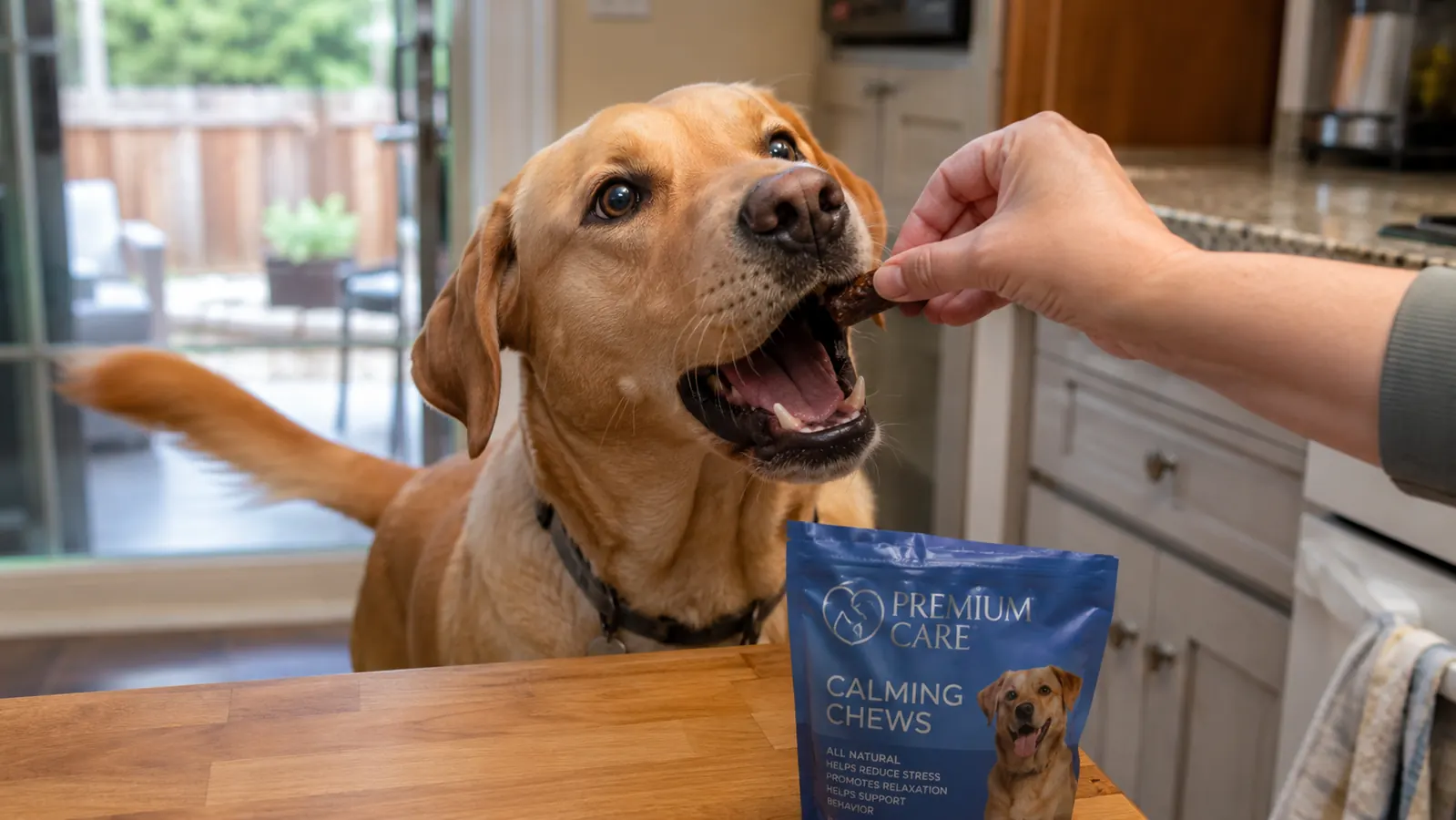
This is a pattern I noticed both with my own dogs and across a lot of the negative reviews, and it doesn't get talked about enough. Biscuit is food-motivated to the point of comedy, so a soft treat-shaped chew is an easy sell no matter what mood he's in. But a dog who is already anxious, especially one who's anxious enough to have a shrinking appetite during the trigger itself, may simply refuse to eat a chew at exactly the moment you're trying to give it to them. I've seen this described more than once in reviews from owners of genuinely nervous dogs, offering the chew during a thunderstorm or right as guests arrive, only to have it turned down or spit out.
The fix, again, ties back to timing. Giving the chew well before the trigger, while your dog is still relaxed and their appetite is normal, solves most of this. Trying to hand-feed a chew to a dog who's already stressed and off their food is setting the product up to fail before it's had a chance to do anything. If your dog is a picky eater in general, it's also worth breaking the chew into a couple of pieces and folding it into a small spoonful of wet food rather than offering it plain, which has worked better than a whole chew alone on the handful of times Biscuit turned his nose up at something new.

The Cost Side Nobody Mentions in the Five-Star Reviews
One thing that rarely comes up in either the glowing reviews or the angry ones is what it actually costs to find out which group your dog falls into. A single bag isn't expensive by pet supplement standards, but if your dog turns out to be a non-responder, you've spent real money and a fair amount of hope on a handful of storm nights before you have your answer. I don't think that's a reason to skip trying it, since the downside is small compared to a vet visit or a prescription, but I do think it's worth going in with a plan rather than an open-ended hope. Decide ahead of time how many well-timed tries you're giving it, three or four storms or car rides, and treat that as your real test, not the first time you happen to remember the bag is in the pantry.
I'd also gently push back on treating this as a subscribe-and-forget purchase before you know it works for your dog. I waited until after Biscuit's first full storm season with it before I set up a recurring order, and I'd recommend the same, buy one bag, run your real test, and only commit to repeat purchases once you've actually seen the pattern play out more than once.
What I Liked
- Simple, labeled ingredient list with dosing by weight, no measuring or guessing
- Genuinely helped Biscuit settle faster during storms once I got the timing right
- Low cost and low risk to try compared to prescription options
- Easy for a food-motivated dog to take without a fight
Where It Falls Short
- Split, honest 4.0 rating means it may do little or nothing for your specific dog
- Does not work like a sedative and won't touch a genuine panic response
- Anxious dogs may refuse to eat it, especially if offered too late
- Underlying research on the full ingredient combination is thinner than some marketing suggests
- Needs several well-timed tries before you can fairly judge whether it's working
The honest story behind a 4.0 star rating isn't that the product is mediocre. It's that it works well for a lot of dogs and does close to nothing for the rest, and most people never find out which group their dog is in because they gave it too late.
Who This Is For
This is a reasonable, low-cost thing to try if your dog's stress looks like ordinary situational jitters, storms, car rides, the vet, fireworks, a busy household, being left alone for an afternoon, the kind of thing Biscuit deals with. It's for owners who are willing to give it ahead of the trigger rather than during it, who understand they're trying a mild supplement and not a sedative, and who are okay giving it a handful of tries before drawing a conclusion. If that's your dog and your expectations, I think it's genuinely worth the low cost of a bag to find out which side of that 4.0 average you land on.
Who Should Skip It and Call a Vet Instead
If what you're actually describing isn't mild stress but something closer to real panic, destructive behavior when you leave the house, shaking that doesn't stop, hiding for hours, self-injury during storms or fireworks, or a dog who can't be left alone at all, please don't try to solve that with a bag of chews bought online. That's separation anxiety or a genuine noise phobia territory, and it typically needs an actual veterinary behavior plan, sometimes including prescription medication, not an over-the-counter supplement. Nothing in this review is veterinary advice, and I'm not qualified to diagnose your dog's anxiety from an article. If your dog's distress is severe, frequent, or getting worse, the right next step is a conversation with your own vet, not another product review.
If your dog's stress sounds more like everyday jitters than a crisis, this is worth the low-stakes try.
Give it a few well-timed tries before deciding. Check today's price on Amazon and see the full ingredient list for yourself.
Amazon Check Today's Price on Amazon →